_1765581354215-B3gV1V2H.png)
Physical Therapy After Stroke: Rebuilding Strength, Movement and Independence
By Angie Read, Founder of Stroke Sisters and Two-Time Stroke Survivor
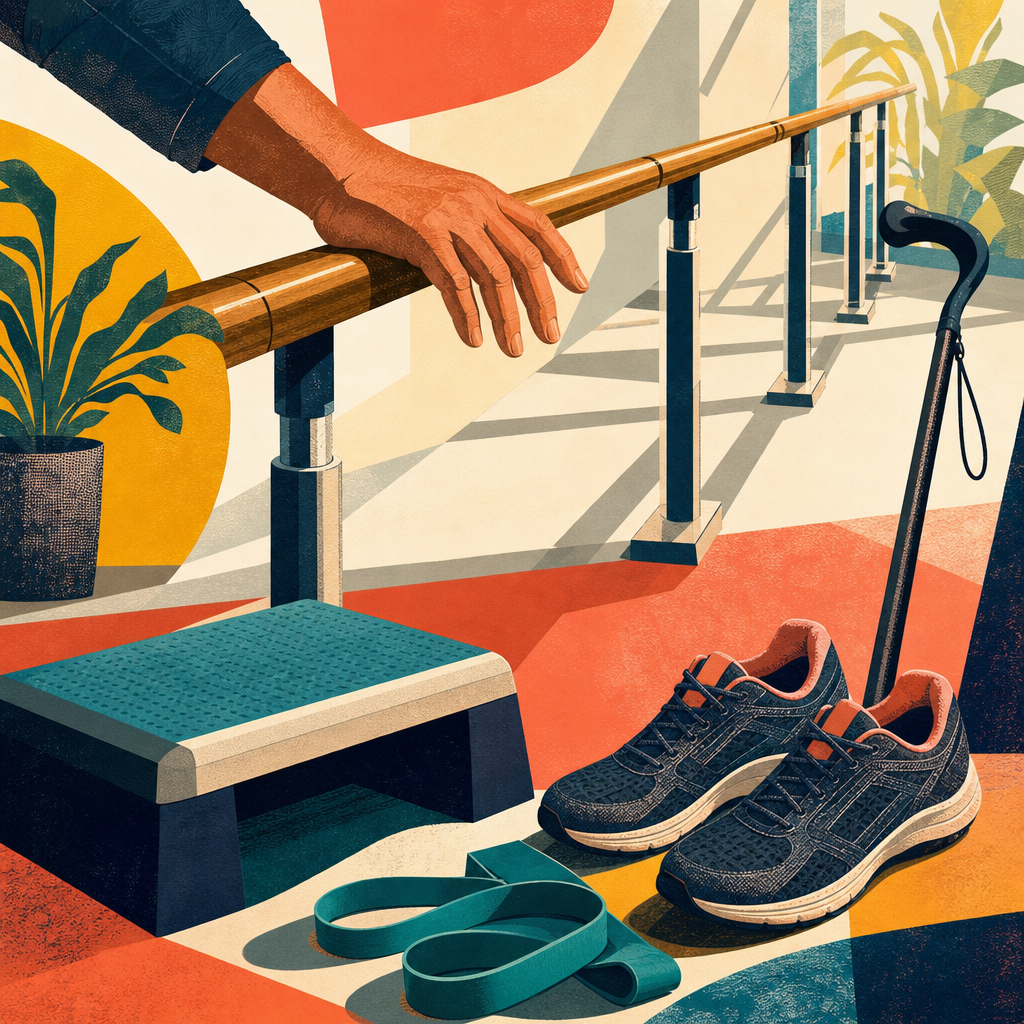
After my first stroke, I had to relearn some of the most basic things most of us never think twice about.
Walking.
Using my left arm and hand.
Moving safely.
Doing things independently again.
Physical therapy became an important part of those first days of recovery. I was fortunate that I regained my ability to walk fairly quickly, but I'll never forget what it felt like to suddenly need help doing something my body had known how to do my entire life.
That's one of the strange things about stroke.
You may know exactly what you want your body to do.
Your body just doesn't cooperate.
Physical therapy after stroke is about much more than building stronger muscles. It's about helping you move as safely, efficiently and independently as possible while your brain and body recover.
And recovery doesn't necessarily end when formal therapy ends.
What Does a Physical Therapist Do After Stroke?
A physical therapist, or PT, focuses primarily on movement and mobility.
Depending on how your stroke affected you, a physical therapist may evaluate:
- Muscle strength
- Balance
- Coordination
- Walking
- Endurance
- Range of motion
- Posture
- Transfers, such as moving between a bed and chair
- Ability to use stairs
- Fall risk
- Muscle tone and spasticity
- Need for mobility equipment or other devices
Your treatment plan should be based on your abilities, limitations and goals.
That last part matters.
The goal isn't simply to perform exercises in a therapy gym.
The bigger goal might be walking to your mailbox.
Getting upstairs to your bedroom.
Going to the grocery store.
Getting on the floor to play with your grandchildren.
Walking into work.
Or getting from your bed to the bathroom without assistance.
Good rehabilitation connects therapy to the life you actually want to live.
Why Does Stroke Affect Movement?
A stroke damages part of the brain.
Depending on where the injury occurs, the brain may have difficulty sending or coordinating signals that control movement.
Some survivors experience hemiparesis, or weakness on one side of the body.
Others experience hemiplegia, which is paralysis affecting one side.
Stroke can also affect balance, coordination, sensation, muscle tone and awareness of one side of the body.
That means difficulty walking after stroke isn't always simply a matter of weak leg muscles.
The brain and body have to work together to produce coordinated movement.
That's why stroke rehabilitation is different from simply "getting back in shape."
What Is Neuroplasticity?
You'll hear this word a lot in stroke recovery.
Neuroplasticity refers to the nervous system's ability to change and adapt in response to experience and practice.
After a stroke, rehabilitation takes advantage of this capacity by giving the brain repeated opportunities to practice meaningful movements and tasks.
The new American Heart Association/American Stroke Association rehabilitation guideline emphasizes sufficient amounts and intensity of task practice as an important part of reducing functional impairment and learning compensatory strategies.
In plain English:
Practice matters.
But more isn't automatically better in every circumstance.
The type, intensity and amount of activity should be appropriate for the individual survivor and stage of recovery.
When Does Physical Therapy Start?
Stroke rehabilitation often begins very early.
The American Stroke Association says rehabilitation should begin in the hospital as soon as possible once the survivor is medically stable.
The new AHA/ASA rehabilitation guideline similarly recommends beginning rehabilitation during the acute phase of stroke care.
Early therapy may look very different from what you imagine when you hear "physical therapy."
At first, goals might include:
Sitting upright safely.
Changing positions.
Getting out of bed.
Moving from a bed to a chair.
Standing.
Taking a few steps.
Maintaining safe positioning.
As recovery progresses, therapy can become increasingly focused on walking, balance, endurance and activities necessary for independence.
What Happens During Physical Therapy?
There isn't one standard stroke PT program.
Treatment depends on what your body needs.
A physical therapist may work with you on areas such as:
Walking
Gait training can help improve the safety and efficiency of walking.
A therapist may work on step pattern, foot placement, balance, weight shifting, speed and endurance.
Some survivors use a cane, walker, ankle-foot orthosis or other device.
Using a device isn't "giving up."
If it helps you move more safely and independently, it's doing its job.
Balance
Stroke can dramatically change balance.
Your therapist may work on sitting balance, standing balance, changing direction, reaching, navigating obstacles or responding safely when your balance is challenged.
Fall prevention is an important part of rehabilitation.
Transfers
Getting from one place to another is a major part of independence.
That might mean learning how to move safely:
From bed to chair.
From sitting to standing.
Onto and off the toilet.
Into a vehicle.
Into a shower.
These may not sound like glamorous rehabilitation milestones.
But when you've needed another person to help you do them, getting that independence back can feel enormous.
Strength and Endurance
Weakness and reduced physical conditioning can both make everyday activity harder after stroke.
A PT may use appropriate strengthening and aerobic activities to improve your ability to move and participate in daily life.
The 2026 AHA/ASA guideline supports appropriately prescribed exercise and task practice as part of rehabilitation.
Range of Motion
Stroke-related weakness, abnormal muscle tone and limited movement can affect joint mobility.
Your rehabilitation team may use positioning, movement and other strategies to maintain or improve range of motion.
The right approach depends on the individual.
Physical Therapy and Occupational Therapy Aren't the Same Thing
This confused me before I had any reason to know the difference.
There can be overlap, but generally:
Physical therapy focuses heavily on movement, balance, walking, transfers, strength and physical mobility.
Occupational therapy focuses on helping you perform the activities you need and want to do in everyday life, such as dressing, bathing, preparing food, using your arm and hand, managing a home and returning to meaningful activities.
Many stroke survivors benefit from both.
And rehabilitation may also include speech-language therapy, cognitive rehabilitation, mental-health care and other specialties.
Stroke recovery is rarely just one thing.
What About the Arm and Hand?
This is another area where PT and OT can overlap.
After my first stroke, regaining use of my left arm and hand was part of my recovery.
Upper-extremity rehabilitation may involve repeated practice of reaching, grasping, releasing and other functional movements.
Depending on your specific needs, an occupational therapist may play a particularly important role in helping you use your arm and hand during everyday tasks.
Don't be surprised if multiple rehabilitation professionals are working toward related goals from different angles.
That's what multidisciplinary stroke rehabilitation is supposed to do.
What Is Spasticity?
Some stroke survivors develop spasticity, which can cause muscles to feel stiff, tight or difficult to control.
An arm may pull toward the body.
A hand may remain clenched.
A leg may feel stiff while walking.
Spasticity can affect comfort, movement, positioning and everyday activities.
Treatment should be individualized and may involve rehabilitation strategies, positioning, stretching or range-of-motion work, braces or splints, medications, injections or other approaches depending on the survivor.
If muscle tightness is painful, worsening or interfering with movement or care, tell your rehabilitation or medical team.
Don't try to aggressively force a stiff limb into position on your own.
What About Electrical Stimulation, Robotics and Other Technologies?
Stroke rehabilitation continues to evolve.
Depending on the survivor and rehabilitation program, therapists may incorporate technologies or specialized approaches such as:
- Functional electrical stimulation
- Treadmill or body-weight-supported training
- Robotic-assisted rehabilitation
- Virtual reality
- Wearable technology
- Telerehabilitation
- Other task-specific rehabilitation tools
These aren't automatically better than conventional therapy.
The right question isn't:
"What's the newest technology?"
It's:
"What is appropriate for my particular impairment and goal?"
Technology should support meaningful rehabilitation, not replace individualized clinical judgment.
Is More Therapy Always Better?
This is more complicated than it sounds.
The new AHA/ASA rehabilitation guideline emphasizes providing sufficient amounts and intensity of task practice.
But the guideline also acknowledges that uncertainty remains about the ideal treatment approach, timing and dose for every rehabilitation intervention.
That means there isn't one magic number of repetitions, minutes or therapy sessions that guarantees recovery.
Your rehabilitation team should consider your medical stability, endurance, goals and ability to safely participate.
And if you're exhausted after stroke, that matters too.
Post-Stroke Fatigue Can Affect Physical Therapy
Stroke fatigue can be overwhelming.
It isn't necessarily the same as being tired because you exercised.
Your brain and body are recovering from an injury, and some survivors experience significant physical and mental fatigue.
Talk with your therapist if fatigue is interfering with therapy.
It may be possible to adjust the timing, intensity or structure of sessions.
Learning to pace yourself isn't the same as giving up.
Sometimes managing your energy helps you participate more effectively.
Should I Exercise at Home?
Usually, the best home exercise program is the one your rehabilitation professional gives you.
That's why I'm intentionally not giving you a generic list of stroke exercises here.
One survivor may be safe practicing standing balance.
Another could fall doing exactly the same activity.
One survivor may benefit from a certain strengthening movement.
Another may have shoulder instability, significant spasticity, pain or another medical issue that makes that exercise inappropriate.
Ask your PT:
What should I practice at home?
How often should I do it?
How many repetitions should I perform?
What symptoms mean I should stop?
Should someone be with me?
When should we make the exercises harder?
Then follow the program designed for you.
Don't Ignore Shoulder Pain
Shoulder pain can occur after stroke, particularly when weakness affects the arm.
If your affected shoulder hurts, tell your rehabilitation team.
Don't allow someone to pull on your affected arm to help you stand or transfer.
And don't assume pain is simply something you need to push through.
Pain can interfere with rehabilitation and deserves evaluation.
What If You've Been Discharged From Physical Therapy?
This is one of the most important updates from the new rehabilitation guidance.
Being discharged from therapy doesn't necessarily mean you're finished recovering.
The 2026 AHA/ASA guideline recommends periodic reassessment and re-engagement in therapy at different points when appropriate.
That matters.
Maybe you initially needed therapy just to stand.
Months later, you're walking and your goals have changed.
Now you want to navigate uneven ground.
Climb stairs.
Improve endurance.
Return to a community activity.
Or perhaps you've noticed that your walking has become less safe.
Ask whether another PT evaluation is appropriate.
The American Stroke Association emphasizes that stroke recovery has no set endpoint. Improvements can continue months or years after formal rehabilitation ends.
What If Insurance Says You're Done?
Unfortunately, access to rehabilitation isn't determined only by medical need.
Insurance coverage, location, transportation, finances and availability of stroke rehabilitation services can all affect care.
If therapy is being discontinued and you still have significant goals or safety concerns, ask your therapist or physician:
Why am I being discharged?
Have I met my goals?
Would another level of care be appropriate?
What should I continue at home?
When should I be reassessed?
Are there community or telehealth rehabilitation options?
The 2026 guideline specifically recognizes telehealth as an option that can improve access for some stroke survivors who have difficulty traveling to rehabilitation.
Recovery Isn't Linear
This may be one of the hardest parts of stroke rehabilitation.
You have a great therapy session.
You walk farther than you've walked before.
You finally do something you've been working on for weeks.
Then the next day feels terrible.
That doesn't necessarily mean you're going backward.
Fatigue, sleep, illness, stress, pain and many other factors can affect performance.
Look at recovery over time rather than judging yourself by one difficult day.
Small Milestones Are Still Milestones
Before my stroke, walking wasn't an accomplishment.
It was just walking.
After my stroke, it meant something entirely different.
Stroke has a way of changing your definition of progress.
Sitting without help.
Standing for 30 seconds.
Taking three steps.
Moving a finger.
Getting into the shower.
Walking to the mailbox.
Climbing a staircase.
Going into a store.
Those things may have once been automatic.
Now they can represent hours, weeks or months of work.
They count.
What If You're Afraid You'll Always Be Like This?
This is something I hear from survivors, particularly early in recovery.
You wake up in a body that doesn't work the way it did before, and you desperately want someone to tell you exactly how much you'll get back.
Unfortunately, no article and no fellow survivor can promise that.
Stroke recovery varies enormously.
Some people regain substantial function.
Others live with significant long-term disability.
Many land somewhere in between.
Early limitations don't necessarily tell the entire story, and neither does another survivor's recovery.
Your rehabilitation team is in the best position to help you understand your specific impairments, progress and goals.
What you can focus on is the next meaningful thing you're working toward.
Not somebody else's timeline.
Yours.
Motivation Doesn't Mean Being Positive Every Day
You're allowed to hate physical therapy sometimes.
You're allowed to be frustrated.
You're allowed to be tired of working so hard to do something you used to do without thinking.
Motivation after stroke isn't about waking up inspired every morning.
Sometimes it's simply showing up.
Doing the work you're able to do safely.
Resting when you need to.
And trying again.
Track Functional Progress, Not Just Exercise Numbers
Instead of measuring only repetitions or minutes, notice what therapy is helping you do.
Can you stand long enough to brush your teeth?
Walk farther before needing a break?
Get out of the car more easily?
Use fewer physical cues?
Navigate your house more safely?
Attend something you couldn't attend a month ago?
Those changes connect rehabilitation to real life.
And real life is the point.
Caregivers Need Training Too
Physical rehabilitation doesn't happen only between a survivor and therapist.
Family members and care partners may need instruction in:
- Safe transfers
- Mobility assistance
- Proper positioning
- Use of walkers, wheelchairs or other equipment
- Fall prevention
- Home exercises
- Knowing when not to help
The new AHA/ASA rehabilitation guideline specifically emphasizes educating and training care partners.
If you're helping a survivor physically, ask the therapist to show you how.
Don't guess.
The wrong kind of assistance can put both of you at risk.
Questions to Ask Your Physical Therapist
You don't have to become an expert in stroke rehabilitation.
But asking good questions can help you understand what you're working toward.
Consider asking:
What are my biggest mobility challenges right now?
What are our current goals?
What should I practice between sessions?
What shouldn't I do by myself?
Am I at risk for falls?
Do I need a brace, cane, walker or other equipment?
What signs would mean I should stop an exercise?
How will we measure my progress?
When should my treatment plan be reassessed?
If I'm discharged, what should I do next?
Physical Recovery Doesn't Have an Expiration Date
This may be the most hopeful message in the updated stroke rehabilitation guidance.
Recovery doesn't have a universal deadline.
Your fastest changes may happen early.
Progress may eventually become slower.
Some impairments may remain.
But formal therapy ending doesn't automatically mean your ability to improve has ended too.
The goal isn't to chase someone else's definition of "back to normal."
It's to keep working toward the safest, strongest and most independent version of your life that's possible for you.
For me, those early steps after stroke meant more than I could have understood before I needed to relearn them.
If you're still working on yours, I hope you give yourself credit for how much effort that takes.
One step is still a step.
Frequently Asked Questions About Physical Therapy After Stroke
When should physical therapy start after a stroke?
Rehabilitation generally begins in the hospital once the survivor is medically stable. The appropriate timing and intensity depend on the individual and should be determined by the clinical and rehabilitation team.
How long do you need physical therapy after a stroke?
There is no universal timeline. Some survivors need therapy for a relatively short period, while others may benefit from rehabilitation at different points over months or years.
Can you improve years after a stroke?
Improvement can continue months or years after stroke. The 2026 AHA/ASA guideline also emphasizes periodic reassessment and re-engagement with rehabilitation when appropriate.
Can I do stroke exercises at home?
Home practice can be an important part of rehabilitation, but exercises should be appropriate for your individual abilities and risks. Ask your PT for a specific home program rather than relying on a generic online exercise list.
Is walking the best exercise after stroke?
Walking may be an important goal for many survivors, but it isn't appropriate as an unsupervised exercise for everyone. Rehabilitation should address the individual's specific mobility, balance, strength and safety needs.
What's the difference between PT and OT after stroke?
Physical therapy generally focuses on mobility, walking, balance, strength and transfers. Occupational therapy focuses more on performing meaningful everyday activities and may work extensively on arm and hand function. Their roles can overlap.
What should I do if therapy has stopped but I still have problems?
Talk with your physician or rehabilitation team about reassessment. Current AHA/ASA guidance emphasizes periodic reassessment and re-engagement with rehabilitation when new goals, decline or other needs arise.
More Stroke Sisters Resources
- Stroke Recovery Timeline
- What to Expect After a Stroke
- Post-Stroke Fatigue
- Rebuilding Confidence After Stroke
- Cognitive Recovery After Stroke
- Mental Health After Stroke
- Invisible Effects of Stroke
Trusted Sources & Further Reading
American Stroke Association: Stroke Rehabilitation
American Stroke Association: Post-Stroke Rehabilitation
American Stroke Association: What to Expect From Stroke Rehabilitation
About the Author
Angie Read is the Founder & CEO of Stroke Sisters and a two-time stroke survivor. She created Stroke Sisters to help women navigate the physical, mental and emotional realities of life after stroke. Angie brings lived experience as a survivor and years of communications and patient-advocacy work to her writing. Her perspective reflects lived experience and research, not a medical credential.
Medical Disclaimer: Stroke Sisters is not a medical provider. This article is for educational and supportive purposes and is not a substitute for professional medical advice, diagnosis or treatment. Physical activity and rehabilitation after stroke should be individualized. Talk with your physician, physical therapist or another qualified healthcare professional before starting or substantially changing an exercise program.
Sudden new weakness, numbness, facial drooping, difficulty speaking, vision changes, severe dizziness, loss of balance or other possible stroke symptoms are an emergency. Call 911 immediately, even if symptoms improve. Do not drive yourself.